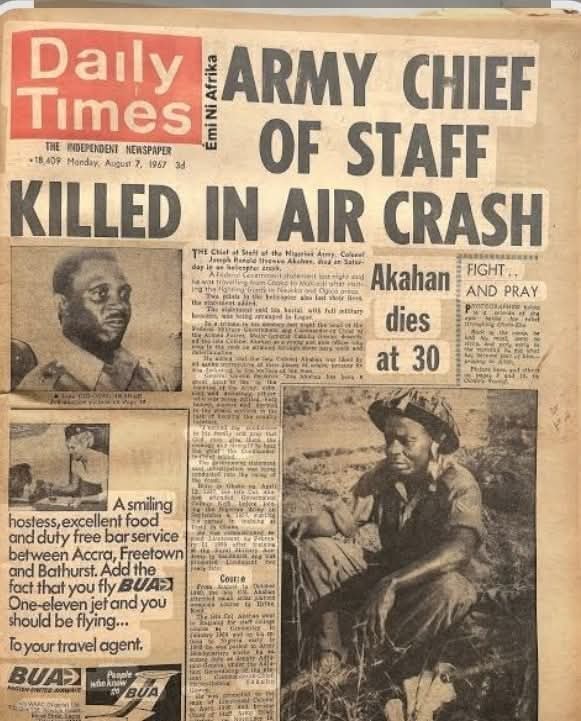
How the Daily Times of August 7, 1967, reported the death of Colonel J. R. I. Akahan, a rising military leader who perished in a helicopter crash amid Nigeria’s Civil War.
On Monday, August 7, 1967, the front page of the Daily Times newspaper delivered devastating news to a nation already engulfed in conflict. The headline reported the sudden death of Colonel Joseph Ronald Ityowua Akahan, the Chief of Army Staff of the Nigerian Army, who had died in a helicopter crash a day earlier, on August 6, 1967.
The news struck a deep chord across Nigeria. Colonel Akahan, only 30 years old, was one of the youngest and most promising officers in the military hierarchy. His death occurred at a crucial point in the Nigerian Civil War (1967–1970), barely a month after hostilities began between the Federal Government and the secessionist state of Biafra.
A Rising Star in the Nigerian Military
Born in Tivland, Benue Province (now Benue State), Colonel Joseph Akahan represented a new generation of Nigerian officers who emerged in the years following independence. A graduate of the Nigerian Military Training College (NMTC) in Kaduna and the Royal Military Academy Sandhurst in the United Kingdom, Akahan had a distinguished military background that earned him rapid promotions.
He was widely respected for his discipline, courage, and leadership. By May 1967, he had been appointed Chief of Army Staff, succeeding Lieutenant Colonel Yakubu Gowon, who had become Nigeria’s Head of State following the 1966 counter-coup.
Akahan’s appointment was significant — not only because of his youth but also because he was one of the most trusted officers among his peers. He was instrumental in reorganising the army during a volatile period marked by ethnic tension, mutinies, and preparations for the impending war.
The Fatal Helicopter Crash
According to reports published in the Daily Times and corroborated by military sources, Colonel Akahan had been on an inspection tour of the Nsukka and Ogoja fronts in Eastern Nigeria, where fierce fighting had broken out between federal and secessionist forces.
On Sunday, August 6, 1967, he boarded a helicopter from Enugu, heading toward Makurdi, the capital of Benue Province. Tragically, the aircraft crashed mid-flight, killing all onboard. The cause of the crash was never definitively established, though it was widely believed to be a combination of poor visibility and mechanical failure.
His death shocked the military and the entire nation. In a war that had only just begun, the Nigerian Army had lost one of its brightest young minds.
National Mourning and Military Reorganisation
In its August 7 edition, the Daily Times front page described the somber atmosphere across the country. Tributes poured in from military and political leaders. Head of State, Lt. Colonel Yakubu Gowon, expressed deep sorrow, calling Akahan’s death “a heavy blow to the army and the nation.”
Flags were flown at half-mast, and an official statement from the Ministry of Defence declared him a national hero. His remains were later transported to his home region in Benue for burial, where thousands attended the funeral to pay their respects.
The military quickly reorganised its command structure to maintain operational momentum in the war. However, Akahan’s absence was deeply felt — not only in the army’s leadership but also in its morale.
Akahan’s Role in the 1966 Counter-Coup
Colonel Akahan had been a key participant in the July 1966 counter-coup, which overthrew the government of Major General Johnson Aguiyi-Ironsi. The coup restored northern officers’ influence in the army and paved the way for Lt. Colonel Yakubu Gowon’s rise to power.
While the counter-coup was controversial for its ethnic implications, Akahan’s role was seen by many as driven by loyalty to the institution rather than personal ambition. His reputation for professionalism remained intact even after the tumultuous events of 1966.
A Symbol of Sacrifice and Patriotism
Colonel Joseph Akahan’s death became a symbol of sacrifice and service during one of Nigeria’s darkest periods. He was remembered as a leader who embodied courage, discipline, and an unwavering sense of duty to the nation.
His legacy endures in Benue State, where the Nigerian Army’s 72 Paratroopers Battalion Barracks in Makurdi was later renamed “Akahan Barracks” in his honour — a permanent reminder of his contributions to the unity and defence of Nigeria.
The Context of the Civil War
At the time of Akahan’s death, the Nigerian Civil War had entered its second month. Federal forces were advancing into the Eastern Region after the secession of the Republic of Biafra, led by Lt. Colonel Odumegwu Ojukwu.
Akahan’s leadership had been pivotal in coordinating federal troops and maintaining discipline within the ranks. His death, therefore, represented not just a personal tragedy but also a strategic setback for the Nigerian Army.
References:
Daily Times, Monday, August 7, 1967 (National Archives of Nigeria)
Federal Ministry of Defence, Military Archives, Abuja
“Profiles of Nigerian Military Officers,” The Guardian Nigeria, 2019