



… Several gaps need to be filled-Accountability Lab
By Lubem Gena, Abuja
Corruption in Nigeria seems to remain unabated as the country has been ranked 145 out of 180 countries with total scores of 25 out of 100 points in the 2023 Corruption Perception Index (CPI) published by Transparency International (TI) Nigeria.
With the stated results, it is clearly indicated that the menace has persuaded and even waxing stronger as the country has moved up to five places above its previous ranking in the 2022 CPI, where Nigeria placed 150 out of 180 countries, and scored 24 of 100 points.
The 2023 CPI which is the first index under the President Bola Tinubu led administration indicates that corruption remains a practice that a war against it must be won.
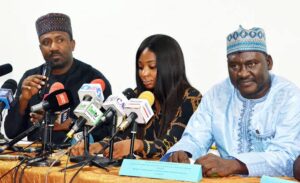
Presenting details of the report to the media in Abuja Tuesday, the head of Nigeria country chapter of TI, Mr. Auwal Musa Rafsanjani said: “The index reveals that Nigeria scored 25 out of 100 points in the 2023 Corruption Perception Index, compared to 24 points in the year 2022 CPI, while Nigeria ranks 145 out of 180 countries, compared to 150 on 2022 CPI results. Nigeria’s score is low the sub-Saharan African average of 33 points. Most African countries show stagnation, ninety per cent of countries in Sub-Saharan Africa scored under 50”.
It could be recalled that Nigeria had its lowest CPI score in 1996, scoring 6.90, and its highest ever being 28 in 2016, in the first year of President Muhammadu Buhari’s administration.
Mr. Musa who is also the Executive Director of the Civil Society Legislative Advocacy (CISLAC), said the scores showed that Nigeria still had a lot of work to do at the national and regional levels pointing out that the country’s score was below the Sub-Saharan African average of 33 points.
“This shows that it is a problem that we have both in the country and at the regional level and that we have to wake up to ensure that we do everything possible to defeat corruption and corrupt practices.
“You can see many reasons why these are happening, political corruption is on the increase, and when you loot the nation, and you are rewarded with the appointment, you will continue to do business as usual. So, at both national and regional levels, we have a lot of work to do to create a conducive atmosphere where development can thrive, and where democracy and electoral transparency can happen”, he maintained.
Mr. Musa however pointed some cheering areas but said efforts must be intensified to deepen such just as he dishes out strategies to be employed in the process.
“Some of the positive points include: The launch of the Beneficial Ownership Register. The Nigerian government launched its Open Central Register of Beneficial Ownership which is also known as the Persons with Significant Control (PSC) register having passed a Companies and Allied Matters Act (CAMA) 202 which supports its establishment.
“To this effect, we are calling on the government through the Corporate Affairs Commission to ensure that this register is updated with information on persons who have significant interest in companies,” Rafsanjani said.
He said that it was also paramount for the various anti-corruption agencies to work with the information in this register which is actionable intelligence.
He said above all, citizens must have unfettered access to this register.
He also said that another reason for the improvement was a vibrant media, civil society and citizenry in demanding transparency and accountability.
He said that all arrests and recoveries by anti-corruption agencies also aided the improvement in corruption perception index as there have been arrests and recoveries of proceeds of crime by Nigeria’s anti-corruption agencies.
According to him, there should be a proper integrity monitoring mechanism in the Nigerian judiciary and that it should cover whistleblowing and other reporting channel as well as the disclosure of assets and conflicts of interest.
He urged the National Assembly to ensure transparency in the implementation of the constituency projects and the relevant agencies should ensure that those found guilty of infractions are brought to book among other measures.
In his contribution while providing highlights to the weaknesses and the reasons why Nigeria’s position had scarcely changed, the Country Director of Accountability Lab Nigeria, Friday Odeh, said so many gaps will need to be filled for Nigeria to exit the worrisome situation.
He noted that judicial and electoral corruption, as well as corruption in the security sector, are some of the key weaknesses that the country needed to improve on.
“First, we have electoral corruption, which I think most of us are aware of. It is no longer news that the 2023 election dashed the hope of Nigerians, most especially those of the young population who were excited to come out to vote in 2023.
“But now we are not sure what will happen in the next elections. Still referencing the 2023 elections, the Nigerian Judiciary was expected to display independence and dispatch justice transparently, as well as in equity and fairness. However, different conflicting rulings by the different courts, have questioned the independence and integrity of the judiciary as an institution.
“The third weakness is the corruption in the security sector. The defence and security sector has accounted for 13.4% of the national budget. Over the years security budget has been the highest, if not the last three years across the years, which is about twice the sum of the next two sectors, talking about education which is 8.2% and infrastructure which is 5.7%.
“The primary aim of the government is to protect the life and property of citizens, we no longer know if that is the priority. Continuous corruption and wasteful expenditure in the security sector are likely to determine the success or failure of the development objectives of this new administration”, he stated.
The Index was aggregated from eight different sources including the Bertelsmann Foundation Transformation Index, Economist Intelligence Unit Country Ratings, Global Insights Country Risk Ratings, PRS International Country Risk Guide, Varieties of Democracy Project, World Bank Country Policy and Institutional Assessment, World Economic Forum Executive Opinion Survey as well as World Justice Project Rule of Law Index.


