By Iorliam Shija
After a long period of dormancy, Mzough U Tiv has once again found its voice and courage to organize a Tiv Day. While I congratulate the Tor Tiv, the leadership of Mzough U Tiv, and Tiv people worldwide on this cultural revival, I cannot help but ask an uncomfortable but necessary question which is why the change of date?
Would Christians be joyful if Christmas were suddenly shifted from 25th December to another day? Culture, like faith, derives its power from memory, continuity, and meaning. When dates are altered without historical justification, symbols are weakened and identity diluted.
On 6th August 2005, just three months and fourteen days before his death, His Excellency, Very Reverend Father Moses Orshio Adasu, former Governor of Benue State, delivered a lecture as Guest Speaker at a Tiv Day organized by the Community of Tiv Students (CTS) at Benue State University, now Rev. Fr. Moses Orshio Adasu University, Makurdi. His topic was aptly titled “Introspection: Key to the Development of the Tiv Nation.”
Before delving into his paper, Fr. Adasu made a profound observation. He noted that such a glamorous and intellectually engaging Tiv Day, organized by mere students, ought naturally to have been the responsibility of Mzough U Tiv. With visible regret, he lamented that Ijir Tamen and Mzough U Tiv institutions that once symbolized Tiv ontology, were effectively dead.
“I have lamented that Ijir Tamen and Mzough U Tiv, which symbolized Tiv ontology, are gone—and with them, the Tiv Nation. They must be resurrected,” Adasu declared.
He further advised that Tiv people at home and in the diaspora must come together to reclaim a collective forum where they could withdraw into themselves, rediscover who they are, and consciously recreate Tiv identity.
In recent years, the growing success of Tiv cultural platforms such as Kyegh Sha Sha (KSS) and the Mutual Union of Tiv in America (MUTA) and Mzough U Tiv UK (MUTUK) annual conventions appears to echo the same concerns raised by the late priest. These initiatives have reignited intellectual and cultural reflection among Tiv thinkers.
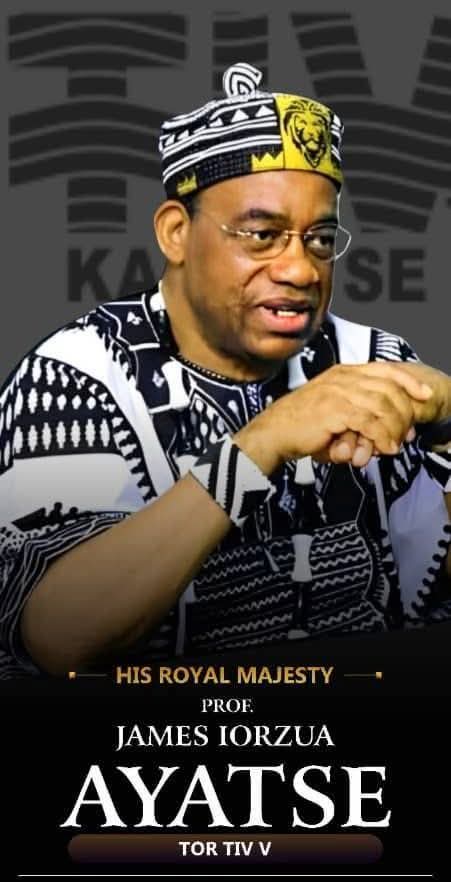
It is perhaps this mounting pressure that the current Tor Tiv, HRM Professor James Ortese Iorzua Ayatse, who marks nine years on the throne on 20th December, has responded to by organizing today’s event in Gboko.But the crucial question remains:l, was this event conceived with Tiv historical reality in mind?
According to Professor Mvendaga Jibo, a foremost scholar on politics and chieftaincy affairs, the process that led to the formation of Mzough U Tiv began on 6th April 1985 during the 60th birthday celebration of the second Tor Tiv, HRM Orchivirigh James Akperan Orshi, at Tse Kur Baka in Buruku Local Government Area. It was there that the Tor Tiv publicly hinted at the need for a non-partisan Tiv forum.
When Orshi ascended the throne on 10th March 1979, he inherited a deeply fractured Tiv society still reeling from the aftershocks of the Nande-Nande and Atem Ityough crises, compounded by the bitterness of the 1979 and later the 1983 gubernatorial elections. While politicians counted victories, the Tor Tiv perceived something far more dangerous, the gradual erosion of Tiv unity and identity.
Thus, at his 60th birthday, he pleaded with his people to fashion a neutral forum to heal Tivland. He even offered a symbolic reward of ₦1,000 to anyone willing to bring Tiv sons and daughters together. That appeal resonated. Meetings followed, delegates were selected, and by 1st June 1985, Mzough U Tiv was formally born during an Ijir Tamen session.
Its objectives were lofty and rooted in unity, peace, cultural preservation, language development, traditional institutions, and socio-economic advancement. Yet, nearly four decades later, one must ask honestly whether Mzough U Tiv has lived up to these ideals.
The body’s failure, sadly, mirrors the very divisions it was created to heal. From its inception, partisan suspicion, particularly the refusal of the then leading political icon late Wantaregh Paul Unongo to participate, cast a long shadow. Politics infiltrated culture, and neutrality was compromised. Tiv Day, conceived as a sacred space for collective memory and cultural renewal, became vulnerable to political rivalry.
Dr. Tesemchi Makar reminds us that Tiv Day, traditionally held in September in Gboko, was designed to commemorate Tiv ancestral migrations, resistance, survival, and eventual consolidation in the Benue Valley, culminating in Gboko’s emergence as an administrative headquarters in 1933 and the creation of the Tor Tiv stool on 19th September, 1946. It was never meant to be an arbitrary festival. It was supposed to hold on the third Saturday in September. In this conception , Tiv day 2025 was on 20th September and next year will be , 19th September.
When dates are altered without explanation or historical grounding, we risk severing Tiv Day from its roots and reducing it to mere ceremony. As Fr. Adasu warned in 2005:
“The future of the Tiv people has become bleak and unpredictable… The metaproblem is founded on lack of leadership in our human institutions.”
If Mzough U Tiv and Tiv Day are truly being resurrected, then they must be anchored firmly in Tiv history, not convenience. If Tiv Day must be moved from September, then let it be moved meaningfully, perhaps to 20th December, marking the anniversary of the Tor Tiv’s election, or to March, the month of his enthronement.
Culture must not float; it must be rooted. Without historical consciousness, revival becomes ritual, and ritual without meaning is emptiness.
Shija wrote from Abuja
08107205745