


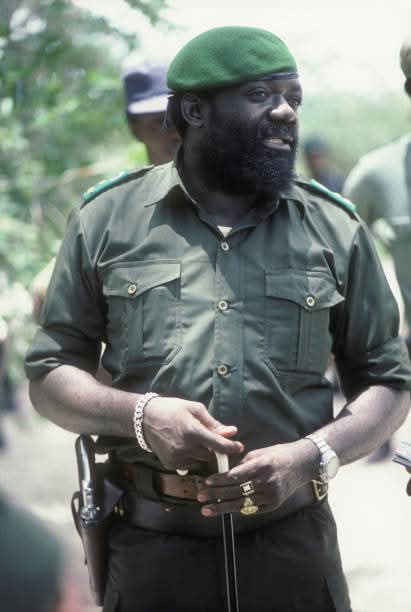
Jonas Malheiro Sidónio Sakaita Savimbi was an Angolan revolutionary, politician, and rebel military leader who founded and led the National Union for the Total Independence of Angola (UNITA).
He remains one of the most polarizing and complex figures in modern African history. Savimbi spent nearly four decades leading a guerrilla insurgency, first fighting against Portuguese colonial rule and later waging a brutal, multi-decade civil war against the Marxist ruling government. He was widely celebrated by his supporters as a brilliant, charismatic freedom fighter, but heavily condemned by critics for orchestrating widespread atrocities and plunging Angola into long-term devastation.
Savimbi was born in Munhango, Moxico province, in central Angola, and belonged to the Ovimbundu ethnic group. His father was a railway station master and a part-time Protestant church worker.
He excelled academically at Protestant missionary schools, earning a rare scholarship from the United Church of Christ to study medicine in Lisbon, Portugal, in 1958.
In Portugal, his political activities against the colonial regime drew harassment from the secret police. He fled to Switzerland, shifting his focus to political science and law, eventually graduating with honors from the University of Lausanne in 1965.
Savimbi was a charismatic leader; he spoke six languages and mobilized many with his oratory power.
Savimbi initially joined Holden Roberto’s National Liberation Front of Angola (FNLA) but broke away due to political and ethnic rifts. Seeking to establish a more inclusive, rural-focused movement, he traveled to China to secure military training and arms under Maoist doctrine.
On 13 March 1966, he officially founded UNITA in the remote eastern village of Muangai. UNITA drew massive support from the Ovimbundu and Chokwe people of central and southern Angola. They effectively targeted the strategic Benguela Railroad and pressured the Portuguese colonial army until Portugal withdrew from Angola in 1975.
Copied


