


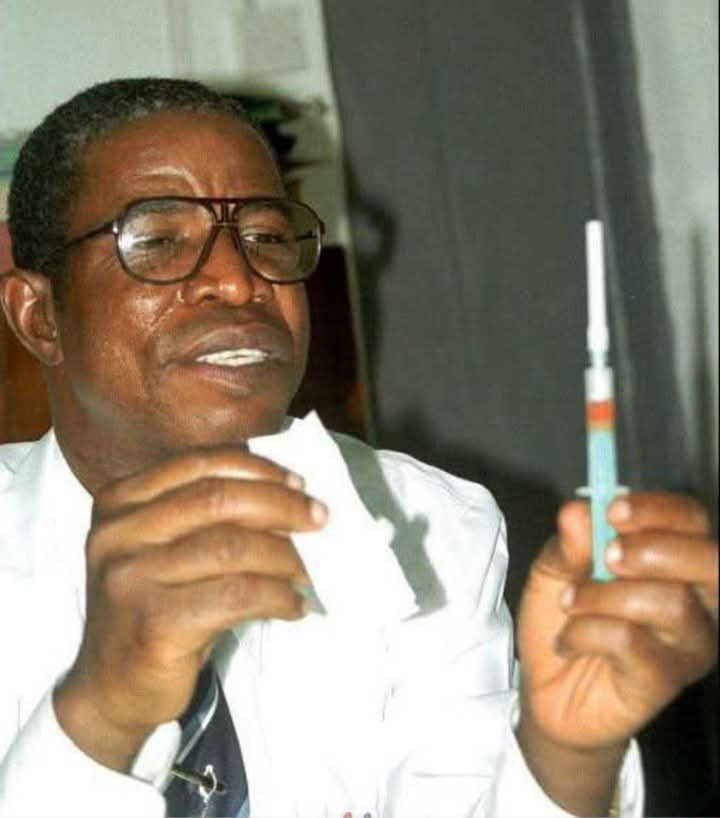
In the late 1990s and early 2000s, the name of Dr. Jeremiah Abalaka became a subject of intense national and international interest after he claimed to have developed a vaccine against HIV and a treatment capable of eliminating the virus from infected people.
At a time when HIV/AIDS was causing widespread fear, claiming countless lives and carrying enormous social stigma, the possibility of a Nigerian doctor discovering an affordable solution generated excitement, hope and controversy.
WHO IS DR. JEREMIAH ABALAKA?
Born on 12 December 1948 in Ajiyolo, in present-day Kogi State, Jeremiah Abalaka studied medicine at Ahmadu Bello University, Zaria, graduating in 1972. He subsequently pursued further medical training and became associated with Medicrest Specialist Hospital in Gwagwalada, Abuja.
His name would later become inseparable from one of Nigeria’s most controversial medical claims: that he had developed a vaccine and treatment for HIV/AIDS.
THE CLAIM THAT CAPTURED NIGERIA’S ATTENTION
In the late 1990s, Abalaka announced that he had developed a vaccine intended to prevent HIV infection and a treatment he claimed could help eliminate the virus from people already infected.
He maintained that his approach could provide an affordable alternative to imported treatments. He also reportedly cited patients who, according to his accounts, had tested negative for HIV after receiving his treatment.
For many Nigerians desperate for an answer to the HIV/AIDS crisis, these claims offered a reason for hope. However, hope and scientific proof are not the same thing.
The crucial question was whether his findings could withstand independent scientific scrutiny and the rigorous clinical trials required to establish the safety and effectiveness of a new medical intervention.
HIS CLASH WITH THE AUTHORITIES
The controversy intensified around 2000, when Nigerian health authorities raised concerns about the use of his purported vaccine without adequate scientific verification.
Abalaka challenged the restrictions and maintained that his work deserved serious consideration. The dispute developed into a broader debate about medical innovation, government oversight, scientific evidence and the right of researchers to pursue potentially important discoveries.
His supporters saw him as a Nigerian doctor attempting to find a solution to a devastating disease. His critics questioned the evidence behind his claims and the risks of using an unverified intervention on vulnerable patients.
THE COURT BATTLE
Abalaka’s legal struggle continued for years. In November 2014, a Federal High Court in Makurdi reportedly delivered a ruling concerning restrictions on his vaccine, a decision that attracted renewed attention to his case.
However, a court ruling about the legality of a restriction is not the same as scientific approval of a medical product. Legal proceedings cannot, by themselves, establish that a vaccine prevents infection or that a treatment cures a disease.
The central scientific question therefore remained unresolved: could his claims be independently demonstrated through properly conducted clinical trials?
DID HE TEST HIS DISCOVERY ON HIMSELF?
Abalaka reportedly stated in interviews that he had tested his preventive vaccine on himself and that his treatment had helped numerous patients.
Such statements contributed to the public fascination surrounding his work. Nevertheless, personal testimony, individual patient accounts and claims of negative test results cannot replace independently verified clinical evidence.
A person testing negative after treatment does not, on its own, establish that a treatment caused the result or that it can reliably eliminate HIV in other patients.
WHAT BECAME OF HIS CLAIMED CURE?
Despite the publicity and prolonged controversy, Abalaka’s purported HIV cure did not become an established, scientifically validated treatment. His claimed vaccine also did not become a recognised, approved HIV vaccine.
As of today, there is no reliable scientific evidence establishing that his method cures HIV.
Modern HIV treatment relies on antiretroviral therapy (ART), which can suppress the virus to very low levels, protect the immune system and enable people living with HIV to live long, healthy lives. Although effective treatment is available, a widely approved vaccine that prevents HIV infection and a generally available cure remain major scientific goals.
THE LESSON FROM THE ABALAKA CONTROVERSY
Dr. Jeremiah Abalaka’s story remains a significant episode in Nigeria’s medical history. It raises important questions about local scientific innovation, public trust, government regulation and the responsibility of medical professionals when presenting extraordinary claims.
Nigerian scientists deserve opportunities, funding and fair evaluation of their discoveries. At the same time, patients deserve protection from treatments whose safety and effectiveness have not been established.
Abalaka’s story reminds us that a discovery can attract worldwide attention without becoming a scientifically proven breakthrough.
His claims generated hope and controversy, but the distinction between a promising idea and a proven medical treatment remains essential.
Ethnic African Stories


